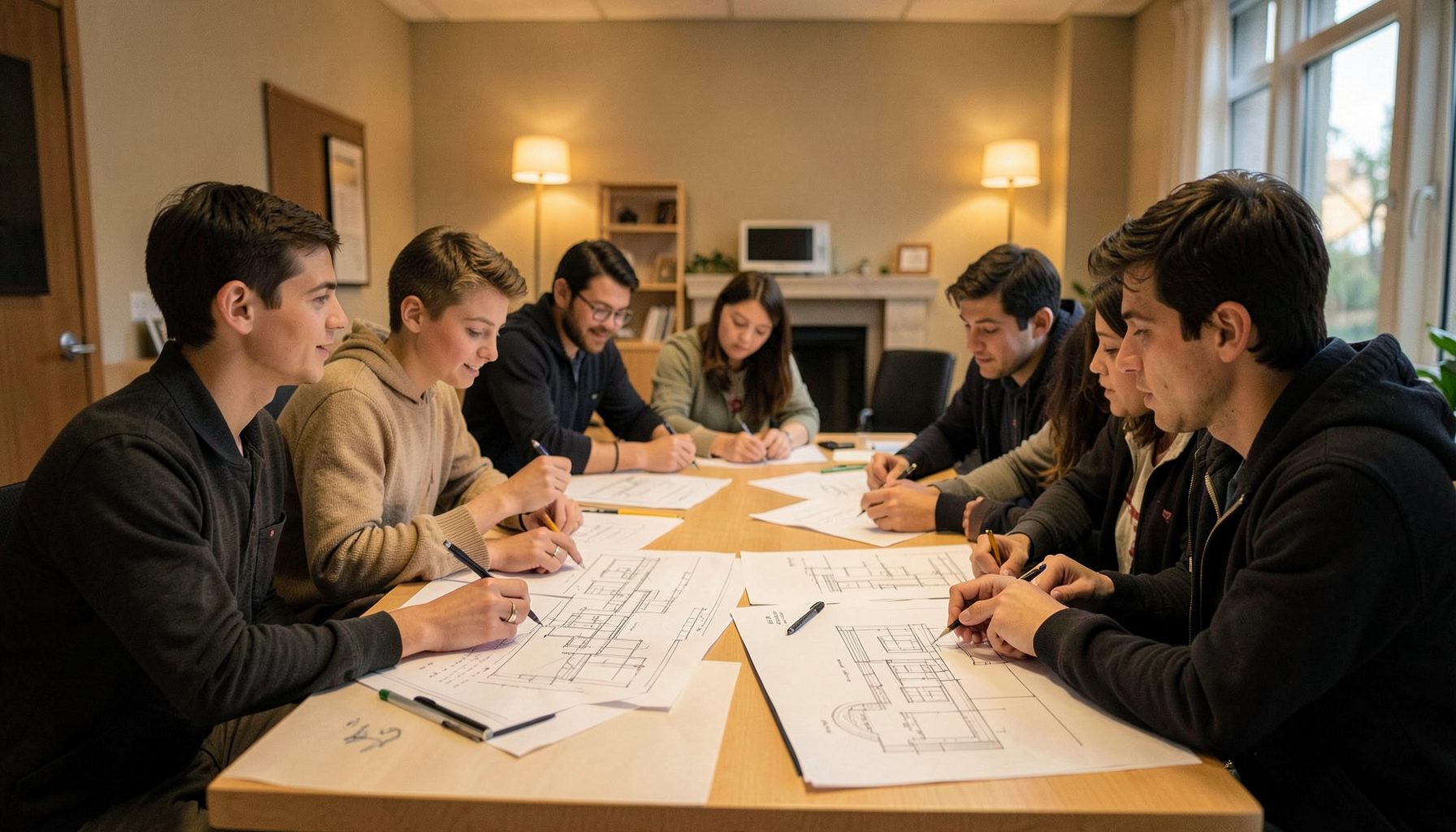
Judging at NAGOYA Archi Fes
The NAGOYA Archi Fes competition brings together a panel of distinguished jurors from leading architecture firms and academic institutions. Each year, submitted graduation design projects are evaluated through a structured review process that emphasizes originality, technical rigor, and conceptual clarity.
The judging framework is designed to give every exhibitor fair consideration while maintaining high standards reflective of the Chubu region's architectural community.
Judging Process
The competition follows a multi-stage review designed to surface the strongest work from across the region. Below is the general flow used in past editions.
Submission & Screening
All entries are collected and checked for completeness against the exhibition guidelines. Works are organized by category for initial review.
First-Round Review
Jurors examine each project individually, assessing drawings, models, and written statements. Projects are scored against the published criteria.
Shortlist & Deliberation
Top-scoring works advance to a shortlist. The full jury convenes to discuss merits, compare projects, and reach consensus on award recipients.
Final Awards
Award decisions are announced during the exhibition. Recognitions may include a grand prize and category distinctions, as determined by the jury.
Jurors
Past editions of NAGOYA Archi Fes have drawn jurors from prominent practices and universities. While the jury roster varies by year, participating firms and institutions across multiple editions have included:
Jurors are listed in past editions with the Japanese convention of 50音順 (syllabary order), honorifics omitted. For the specific jury lineup of a given year, please refer to that edition's event materials.
Competition Content & Criteria
Entries are evaluated across several dimensions. While exact weighting may vary by edition, the following areas have consistently guided the jury's assessment:
| Criterion | What Jurors Consider |
|---|---|
| Concept & Originality | Clarity of the design idea, freshness of approach, and the strength of the underlying thesis. |
| Technical Execution | Quality of drawings, models, structural logic, and attention to detail in the presentation. |
| Spatial & Contextual Response | How well the project engages its site, program, and broader urban or environmental context. |
| Communication | Effectiveness of the visual and written narrative in conveying the design intent to the jury. |
In addition to the core competition, past editions have included curated programming and special content developed by the student organizing committee alongside the jury.
The judging panel at NAGOYA Archi Fes is assembled each year to reflect a broad spectrum of expertise within the architectural profession. Jurors are drawn from established design practices, academic departments, and the wider built-environment community, ensuring that submitted graduation projects are reviewed from multiple perspectives. The selection of jurors emphasizes not only professional achievement but also a demonstrated commitment to nurturing emerging talent. This diversity of background and viewpoint helps guarantee that every project receives a thoughtful and balanced evaluation, grounded in both industry realities and academic ideals.
The evaluation framework used by the jury is structured around several core criteria that remain consistent from year to year. Originality of concept, technical execution, and the clarity with which a student communicates their design intentions are all weighed carefully during each review stage. The process is deliberately transparent, allowing exhibitors to understand how their work is being assessed and what qualities the jury values most. This consistency provides a stable reference point for students preparing their submissions and helps maintain a high standard across the entire exhibition.
A multi-stage review process ensures that no single juror's impression determines the final outcome of any project. Initial screenings allow the panel to survey the full breadth of submitted work before more focused discussions take place on shortlisted entries. Throughout these stages, the jury engages in structured dialogue, comparing notes and debating the relative strengths of each design. This collaborative approach prevents hasty judgments and gives each project a fair hearing, while also allowing the panel to identify thematic trends and emerging directions within the year's cohort of graduating students.
The judging process is designed with the exhibitor experience firmly in mind. Feedback from the jury is framed constructively, focusing on how each project might evolve and what aspects of the design show particular promise. For many students, participation in NAGOYA Archi Fes represents their first encounter with a formal professional critique, and the panel approaches this responsibility with care and respect. The goal is not merely to rank projects but to contribute meaningfully to each student's development as they prepare to transition from academic study into professional practice.
Beyond the evaluation of individual submissions, the jury's work offers a valuable snapshot of the current state of architectural education in the region. The projects presented at NAGOYA Archi Fes reflect the concerns, methods, and ambitions of a new generation of designers, and the panel's deliberations often surface broader observations about where the field is heading. These insights are shared with the wider community through the exhibition's programming, fostering a productive dialogue between students, practitioners, and educators. In this way, the judging process serves both the immediate competition and the long-term health of the architectural community it represents.
Explore Further
Review award-winning projects from previous years, or learn about venue details and exhibitor guidelines.